Friday, February 20, 2015

Vacant Lot Plans in Cleveland

The City of Cleveland’s City Planning Commission proposed and initiated an eight step plan for the reuse of vacant lots. The plan would be used to outline the re-purposing of 56 vacant lots throughout the city. The area of Cleveland is about 82.47 sq miles, so this project covered a massive amount of land. In addition, they have created a land bank consisting of over 7,500 vacant lots under public control in order to promote urban agriculture. They proposed plans to transform old/unused railways into greenways and trails, and updated zoning policies to preserve areas for urban farming and wind turbines.
The Eight Steps:
1.      Stabilization
2.      Urban Agriculture
3.      Storm water management
4.      Greenspace Expansion
5.      Alternate Energy
6.      Contamination Remediation
7.      Land Assembly
8.      Sustainable Development Pattern


                                                     One of Cleveland’s Community Gardens

In practice these steps resulted in more things being planted throughout the area, more than 230 community gardens/farms being established, and trees being planted on vacant lots to improve community air quality. Other functions that were improved include the creation and retention of nutrient-rich soil, improved aeration, and increased water-holding capacity. In addition, the practices that the caretakers of the lots have implemented promote soil fertility, reduces the need for irrigation, filters storm-water, reduces reliance on weed-killers and pesticides, controls erosion, and reduces weeds.In 2009 the City of Cleveland allocated $500,000 of Neighborhood Stabilization Program (NSP) towards the creation of the 56 sustainable vacant lot re-use projects mentioned above. There were 13 individuals involved with the creation of this plan, along with 17 partner agencies.


This plan was implemented in a city that is both much larger than Springfield and has better financial resources. However, that is not to say that Springfield cannot create and implement a large-scale plan to tackle the city’s vacant lot issue. Already, the City of Springfield has created the Memorial Tree Fund. For $110.00 the city will plant a tree that you can dedicate in honor of a loved one and will maintain it for three years. In late 2014 a Mow-to-Own project was proposed. This would allow people who live next to a vacant lot to care for it for a designated period of time, and when that time has elapsed they would be given the property. In addition, Clark County has established a Land Bank.
         
                      
A Mow-To-Own Property
         
However, there is still a lot of room for improvement. The creation of a program in partnership with local schools to create and care for gardens within the city are a possibility. If land cannot be procured, students could care for individual potted plants. Community gardens or rain gardens being created in some of Springfield’s vacant lot would help remedy both the weed and erosion problems. In addition, having added vegetation such as trees, shrubs, more controlled grass growing in lots would not only remove the need to mow, but also help to improve air quality and the aesthetic appeal.

Resources/Sources:


Cleveland's Plan To Stop CSO's

Cleveland is one of many cities in the northeast part of the U.S. that uses a combined sewage system. This is where both sewage and rain runoff use the same pipes. The problem with this is that heavy rainfall can lead to combined sewage overflow, where the sewage gets dumped, before it can get treated, into the lakes, rivers, etc... Cleveland's plan to combat these CSOs is by creating a Green Infrastructure pilot with The Northeast Ohio Regional Sewer District. Cleveland's plan will spend around 44 million dollars on around 20,000 vacant lots spread across 8 years, which it will achieve in 2018. This will soak up the rain water, so less of it gets into the combined sewers. Also the plants will take carbon dioxide out of the atmosphere. As if that wasn't good enough, they  increase the rate of ground water purification. To learn more about these benefits, you can visit this website, "http://www.envirothon.org/pdf/2012/04_EPA_green_infrastructure.pdf"
To help out around Springfield, students can talk to their teachers about either raising money to purchase and maintain their own vacant lots, or talk about teaming up with the Promise Neighborhood.
(Shows the amount of CSOs before and after a similar plan. Acquired from "http://grcity.us/enterprise-services/Environment-Services/Pages/Combined-Sewer-Overflow.aspx")


(More recent figure about CSO reduction. Taken from http://ottawa.ca/en/residents/water-and-environment/sewers-and-septic-systems/overflow-activity)
(Combined sewer overflows during dry and wet weather taken from http://www.epa.gov/sciencematters/april2012/overflows.htm)
Students can talk to their teachers about either raising money to purchase and maintain their own vacant lots, or talk about teaming up with the Promise Neighborhood.

Improving Vacant Lots

Amanda Crawley & Emily Norrod

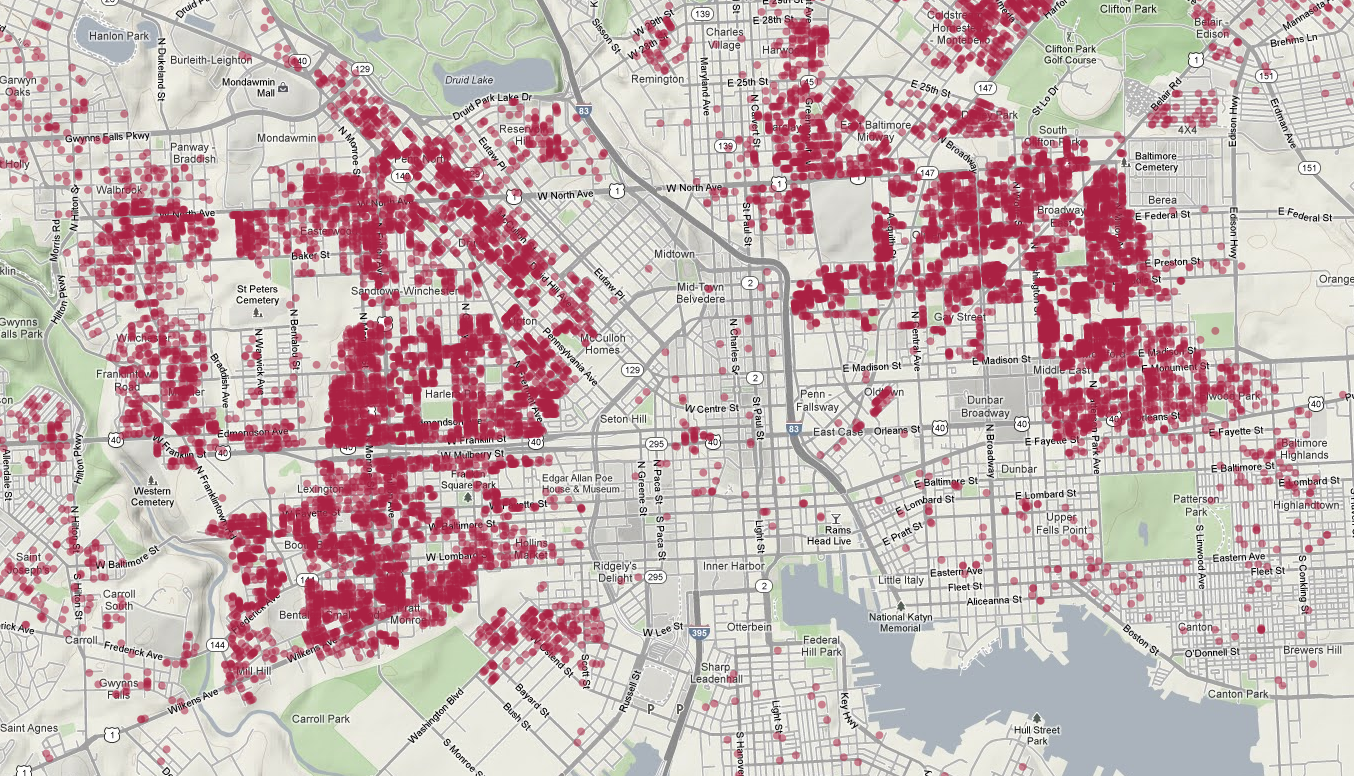
The city of Baltimore, MD has numerous vacant lots scattered across the city creating a financial burden for the city government and an eyesore for its citizens. In April of 2012, Mayor Stephanie Rawlings-Blake dedicated a plot of land in West Baltimore as the “Upton Edible Garden.” This new garden had six raised garden beds on a wood chip covered ground. The garden was a part of a program called “Power in Dirt” which is meant to help revitalize vacant lots in the city. Vacant lots are a big problem in this city with more than 16,000 vacant homes (about 23% of all homes).
Map showing vacant lots in Baltimore, MD 

Through the "Power in Dirt" program, operating for only seven months at the time, Baltimore has adopted 400 lots. The lawn company ScottsMiracle Gro. generously donated $25,000 towards this program to to help ensure the community has the ability to grow healthy food so the residents in the area have better food options. Generally the town only receives fresh vegetables and fruit maybe once a week through a farmer's market. The empty lots in Baltimore can be applied for adoption through a 9 month period for $120 to turn on water for a hose in the lot. Mini grants were given for the program to be able to turn on the water for the garden to thrive.
https://www.baltimorebrew.com/content/uploads/2012/04/upton-garden-raised-beds.jpg 
A picture showing some of the raised garden beds of the Baltimore, MD "Upton Edible Garden"
 
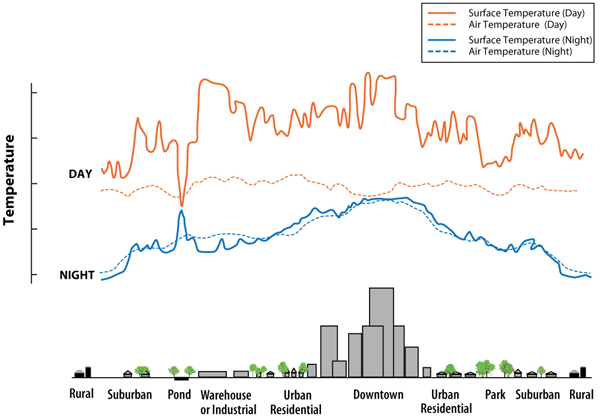
Vacant lots create many problem in cities across the country not just financially or aesthetically, but also environmentally. The soils of abandoned lots often have a heavy buildup of debris and trash leading to potentially toxic substances in the often heavily compacted soil. Both of those factors (toxic substances and compacted soil) negatively affect the local water supply. City soils have also often lost or had destroyed much of the material in them that helps sustain life and naturally filter water. Reintroduction of plants to this type of soil will aid in rectifying this. Another issue that isn’t often thought about is the effects urban areas have on temperatures. Urban areas occasionally have higher temperatures than rural areas because the surfaces prevalent in urban areas absorb heat (whereas in rural areas, heat is evaporated off of vegetation and soil). Having the additional green areas in cities will help lower the overall temperature in cities where this is an issue. With the introduction of an urban garden, the quality of not only the city and it’s health increase, but also the environment.


“Surface and atmospheric temperatures vary over different land use areas. Surface temperatures vary more than air temperatures during the day, but they both are fairly similar at night. The dip and spike in surface temperatures over the pond show how water maintains a fairly constant temperature day and night, due to its high heat capacity.”


Turning to a more local view on vacant lots, we know that the problem is just as big here as it is in Baltimore. To improve vacant lots in Springfield, OH, we cannot just do what we see as best. In order to find a sustainable solution to this problem, there needs to be support from the community as a whole. We have put together a potential series of steps to take to hopefully achieve this community support.

Step 1 - Gather a survey together and pass them out to the residents in Springfield, and in Lincoln Elementary.The students can take them home, or it can be sent out electronically for the parents/guardians to fill out with them. This survey will ask a series of questions on how said person feels about our vacant lot(s) and how they would like if it were fixed into a garden of sorts. This survey can be a rated one, on 1 being if they strongly disagree, and a 5 being that they strongly agree with the statement at hand. They will also be asked on whether or not they would like to participate in helping and if so they can meet at designated area at the end of the survey

Step 2- Create a meeting of sorts for all who is interested in helping making the vacant lot a garden. At the end of the survey in step 1 there can be an email address to send their contact information to if they are interested in learning how they can help with this project. After receiving all the emails we can gather on how many will be there at the meeting to decide where to meet at.
Step 3- At the meeting decide on a garden to make the vacant lot into and assign people in the community jobs to do for this project for it to work. For example: 5 of the people can take all the trash out of the lot, 5 of the people can prepare it for gardening, by taking out weeds and roots.etc.

Sources: 
http://repository.upenn.edu/cgi/viewcontent.cgi?article=1044&context=mes_capstones
http://www.abcdinstitute.org/docs/kelloggabcd.pdf 

Thursday, February 19, 2015

Vacant Lots and Denver, Colorado

One of the problems that plagues urbanized cities is the abandonment of previously occupied land. This can be usually caused by rapid population shifts in cities. In most major cities in the U.S and around the world, vacant land that consists of weed lots, garbage strewn underdeveloped spaces especially concentrated in low-income neighborhoods or areas. This usually increases crimes that become blights on the neighborhood. Vacant land typically results from human migration, deindustrialization, environmental disaster, decreased birth rates or contamination, and occurs at various concentrations in cities across the world. The good news is that vacant, underutilized land has the potential to provide cities with opportunity to create and develop new ecosystems that support biodiversity and increase the provisioning of vital ecosystem services for urban residents. Denver, Colorado is a good example of this. As a rapidly growing urban center, Denver must cope with the challenges of expansion and pressures that growth can place on low-income, inner-city residents. With Denver’s population of about 554,636 people is about 32% Latino and 10% African American. The organization involved is the Gardens for Growing Healthy Communities. They represent a partnership between Denver-based community organizations, the University of Colorado and community residents. The Gardens for Growing Healthy Communities collaborative brings together a number of different community groups and academic and government institutions, each with different strengths and capabilities. Community participants play a vital role in shaping garden design, building and planting gardens, and providing ongoing maintenance to gardens. Community groups include: Denver Urban Gardens, a well-established organization that brings gardens to Denver’s urban areas and has a great deal of influence on local policy; Groundwork Denver Inc., a nonprofit dedicated to restoring vacant and underutilized urban land (e.g., urban brownfields); and Front Range Earth Force, a nonprofit that works with youth around environmental stewardship.
The strategy that the organization, Gardens for Growing Healthy Communities, employed is transforming unused land into urban gardens in moderate and low-income neighborhoods which have higher concentrations of Latino and African American residents who generally live below the poverty line. According to the Gardens for Growing Healthy Communities, the goal of this project is to understand the role of community gardens as a catalyst for broader neighborhood improvements and public health changes. As a result, the once vacant lots of land once strewn with garbage now bloom with new life in some of Denver’s poorest neighborhoods. Denver Urban gardens has been transforming unused lots onto community gardens, creating pockets of green in the midst of inner-city communities. A recently formed collaborative, Gardens for Growing Healthy Communities, studies how the gardens impact community health and translates finding for stakeholders. These urban oases foster neighborhood ties and promote physical, social, and mental well-being. By providing access to fresh organic produce, opportunities for physical activity, contact with nature, and neighborhood meeting places, these gardens promote physical and mental health in communities with diverse residents. Although Springfield is not a highly urbanized or major city, with the number of vacant land available, the process of transforming them to gardens is very feasible especially in the lower income areas in the Southside areas of Springfield Ohio. This would foster inter communal relations and also lead to social and environmental benefits like crime and noise reduction, recreation spaces, beautification for the neighborhoods etc.
As a result of transforming the vacant lots there is an improvement to the earlier layer of earth being misused and its lack of vegetation. They used heavy machinery to clear out the land as well as soil tests to determine the composition and volume of soil amendments require. The soil needs to be mixed in order for the soil to be porous as well as even throughout for the roots of vegetation to hold onto. The land will have the some kind of crops in it year round so the soil will not degrade by the difference in its vegetation. Also there is investing in permanent irrigation systems for the community garden. The with later movement of the soil there would be a reduction of tillage which minimizes the loss of organic matter and protects the soil surface with plant residue. All choices on when to start the project are made in relation to the nature of the soil they are currently working on. With Denver, Colorado’s precipitation levels this is most likely to happen in May.


Figure 1: Precipitation in Denver, Colorado.
Figure 2: Precipitation Denver, Colorado.


In order to transform vacant lots in a community it really does take a group effort that is fully dedicated. For example Denver Urban Gardens began to take the lead to start of the project and the simple basics. Denver Urban Garden provided working volunteers of all ages, groups of technical assistance, helping residents plan, design, coordinate, and construct urban gardens in their neighborhoods. Not only that but they offered to trainings about herbs, composting, tractors, food preservation, water conservation, and other gardening skills. They are trying to promote and maintain the gardens. Eventually the program grew and they had the Department of Anthropology at the University of Colorado Denver and the Department of Preventive Medicine and Biometrics at the University of Colorado Health Sciences Center in the School of Medicine provide coordination, funding, and researchers for the effort. One of the biggest actions taken was monitoring since 2002. They university participated by offering students and researchers volunteers get informed of the health impact of gardens around the communities. The turn out was so successful they had data of about 30 Denver Neighborhoods with a focused pilot project in 14 community gardens in 2 Northern neighborhoods. The average cost to make a new garden it cost $10,000 and making any other adjustments about $3,000-5,000. What helps them out with maintenance cost is the Denver’s Department of Park and Recreation donates resources. 


Some ways to get the community involved are the immense the increased qualities of community as well as the physical benefits of gardening. There is a definite link between urban gardening and improved perceptions of physical and mental well-being. Community gardens specifically located in low-income areas were four times more likely to catalyze efforts to deal with concerns than in higher income areas. These gardens influence several dimension of health by having these sanctuaries that promote physical, social, and mental well-being. It also has a positive effect on dietary intake. Training and education about herbs, composting, tractors, food preservation, water conservation, and other gardening skills are provided for this program. Children’s involvement can start with exciting books about gardening in order to have them aware of how to make the earth a more beautiful place. From here a space can be provided for a specific class or group within a school that gives awards for best effort. This can be a yearly trophy won for the room since kids always need an incentive.


Sources: